

Deformities of the Foot: Causes, Symptoms, and Treatment in Orange, CA
Dealing with deformities of foot structures can cause significant daily pain and severely limit your natural mobility. At Renew Podiatry in Orange, CA, Dr. Charles Baik and our team provide comprehensive care to uncover the exact causes behind your structural foot changes. We carefully evaluate your unique symptoms whether you are struggling with bunions, hammertoes, or collapsed arches to understand exactly how the condition impacts your life. Through personalized, advanced treatment plans, we are dedicated to correcting these painful conditions and restoring your comfort with every step you take. For more information, contact us or schedule an appointment online. We are conveniently located at 705 West La Veta Ave, Suite 109, Orange, CA 92868.
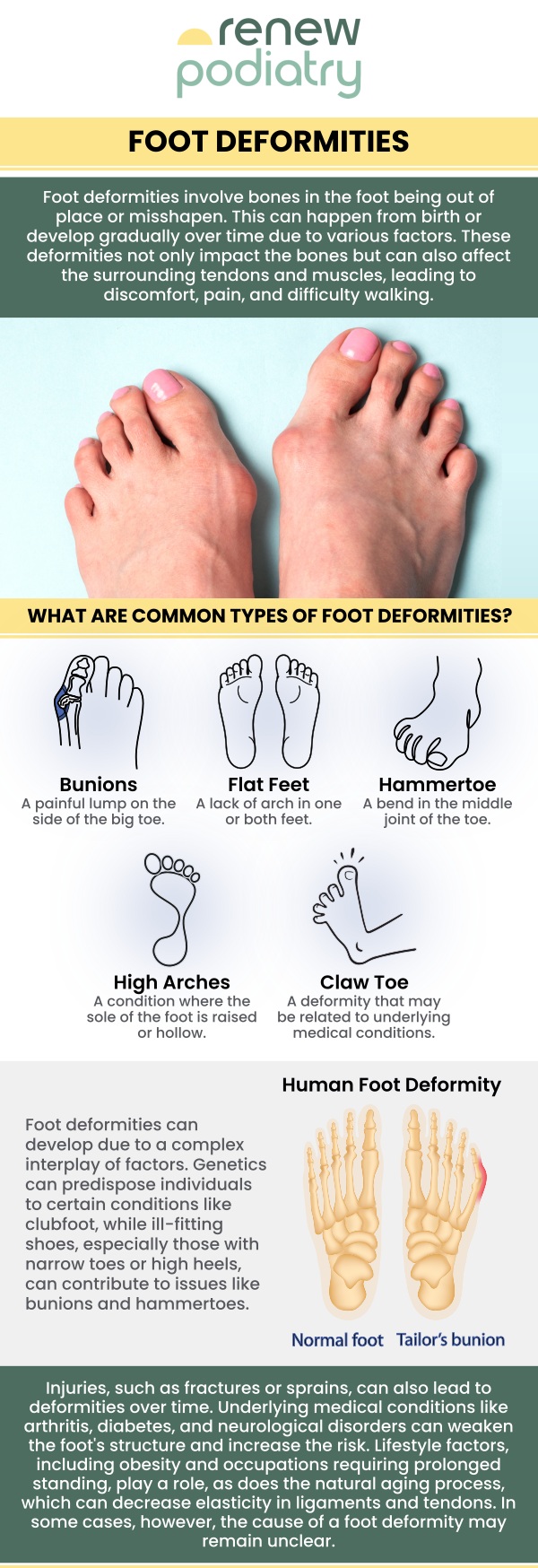
Table of Contents:
What are deformities of the foot?
What are the most common types of foot deformities?
What causes deformities of the foot to develop?
What symptoms are associated with foot deformities?
Can foot deformities affect walking, balance, or mobility?
Can foot deformities become worse over time?
When should you see a podiatrist for a foot deformity?
Can custom orthotics help manage foot deformities?
Why choose Dr. Charles Baik, and team for foot deformity treatment at Renew Podiatry?
Deformities of the foot refer to structural abnormalities or physical changes in the alignment of the bones, tendons, ligaments, and joints that make up your foot and ankle. Because the foot is a highly complex mechanical structure consisting of 26 bones and over 100 muscles, tendons, and ligaments, even a minor misalignment can significantly alter its natural shape. Over time, these structural shifts can cause toes to bend unnaturally, arches to collapse, or prominent bony bumps to form, leading to severe imbalances in how you bear weight and move throughout your day.
At Renew Podiatry in Orange, CA, our team frequently evaluates patients dealing with these painful structural changes. Dr. Charles Baik, DPM, notes that while some individuals are born with congenital foot deformities, many others develop them gradually due to a combination of lifestyle factors, improper footwear, repetitive wear and tear, or underlying medical conditions like arthritis. Understanding that these deformities are often progressive, our clinic focuses on early intervention to prevent the condition from worsening and to restore proper foot mechanics.
The human foot is a complex structure, meaning deformities can take many different shapes. At Renew Podiatry, Dr. Baik and his team frequently treat the following common foot deformities:
• Bunions (Hallux Valgus): A bony bump that forms on the joint at the base of the big toe, causing the toe to point inward toward the lesser toes.
• Hammertoes, Claw Toes, and Mallet Toes: Conditions where the toes bend abnormally at the middle or end joints, often resembling a hammer or claw.
• Flat Feet (Pes Planus): A condition where the arches of the feet collapse, causing the entire sole to touch the floor when standing.
• High Arches (Cavus Foot): An abnormally high arch that places excessive pressure on the heel and the ball of the foot.
• Bone Spurs: Bony growths that develop along the edges of bones, frequently occurring in the heel (heel spurs) or near joints affected by arthritis.
The development of deformities of foot structures is rarely due to a single cause. In most cases seen at our clinic, it is a combination of factors, including:
• Genetics and Heredity: You may inherit a specific foot type or biomechanical flaw that makes you more susceptible to deformities.
• Improper Footwear: Consistently wearing shoes that are too tight, too narrow, or high heels can force the toes into unnatural positions.
• Trauma or Injury: Fractures or severe sprains can damage the foot’s structural integrity, leading to a deformity as it heals.
• Medical Conditions: Inflammatory diseases like rheumatoid arthritis, osteoarthritis, and nerve/muscle disorders can weaken foot structures.
• Aging: As we age, ligaments and tendons can stretch or weaken, causing foot shapes to change.
When patients seek treatment for a foot deformity, their symptoms can range from mild discomfort to severe, debilitating pain. Podiatrists recommend watching out for these common signs:
• Noticeable changes in the physical shape or alignment of the toes, arch, or heel.
• Pain, aching, or throbbing in the feet, especially after standing, walking, or running.
• Tender swelling and visible flare-ups of redness or inflammation encircling the troubled joints.
• The development of corns or calluses where misaligned toes rub together.
• Severe limitations in your footwear choices due to painful friction, pressure, or an overall poor fit.
• Stiffness or a restricted range of motion in the foot or toes.
Can foot deformities affect walking, balance, or mobility?
Yes. Your feet are the foundation of your body. Dr. Charles Baik often cautions patients that when deformities of foot mechanics alter your natural gait, it forces your body to compensate. This not only makes walking painful but can also throw off your balance, increasing the risk of falls. This altered gait can cause a chain reaction of pain traveling up your legs, leading to knee, hip, and lower back issues.
Most foot deformities are progressive, meaning they will gradually worsen if left untreated. For example, a small bunion can eventually become completely rigid, causing severe pain and making conservative treatments less effective. Early intervention by the team at Renew Podiatry is the best way to slow or halt the progression of the deformity.
You should schedule an appointment with Dr. Baik at Renew Podiatry if you notice a physical change in the shape of your foot, experience chronic foot pain, have swelling that doesn’t subside, or find that your condition is limiting your daily activities. Even if a deformity is not currently painful, an evaluation by our team can provide you with preventative strategies.
Absolutely. Custom orthotics are one of the most effective conservative treatments for managing foot deformities. Unlike over-the-counter insoles, the custom orthotics prescribed by Dr. Baik are specifically engineered from precise molds of your feet. Our clinical team at Renew Podiatry specializes in crafting high-quality orthotics tailored to correct biomechanical imbalances and prevent flexible deformities from progressing.
When you choose Renew Podiatry in Orange, CA, you are choosing a team that puts your health and comfort first. Dr. Charles Baik brings extensive experience and specialized training in diagnosing and treating all types of foot deformities.
Our clinic takes a comprehensive, patient-first approach:
• Thorough Diagnostics: The Renew Podiatry team utilizes advanced imaging tools to accurately assess the severity of your condition.
• Personalized Treatment Plans: Dr. Baik believes in exploring conservative options first—such as custom orthotics, padding, and physical therapy.
Don’t let foot pain hold you back. Contact Renew Podiatry in Orange, CA, today to schedule a consultation with Dr. Charles Baik, DPM, and our dedicated team to take the first step toward healthier, pain-free feet! We are conveniently located at 705 West La Veta Ave, Suite 109, Orange, CA 92868. We serve patients from Orange CA, Santa Ana CA, Tustin CA, Irvine CA, Anaheim CA, Westminster CA, Yorba Linda CA and surrounding areas.

Check Out Our 5 Star Reviews


Additional Services You May Need
▸ Heel Pain Treatment
▸ Laser Fungal Nail Treatment
▸ Ingrown Toenail Treatment
▸ Ankle Sprain Treatment
▸ Foot and Ankle Medicine & Surgery
▸ Orthotics Custom
▸ EPAT/Shockwave Therapy
▸ Hammertoe
▸ Arthritis Treatment
▸ Diabetic Foot Care
▸ Flat Feet Treatment
▸ Foot Warts Treatment
▸ Remy Laser
▸ Medical Pedicure




 Send Text
 How May I Help You?

